


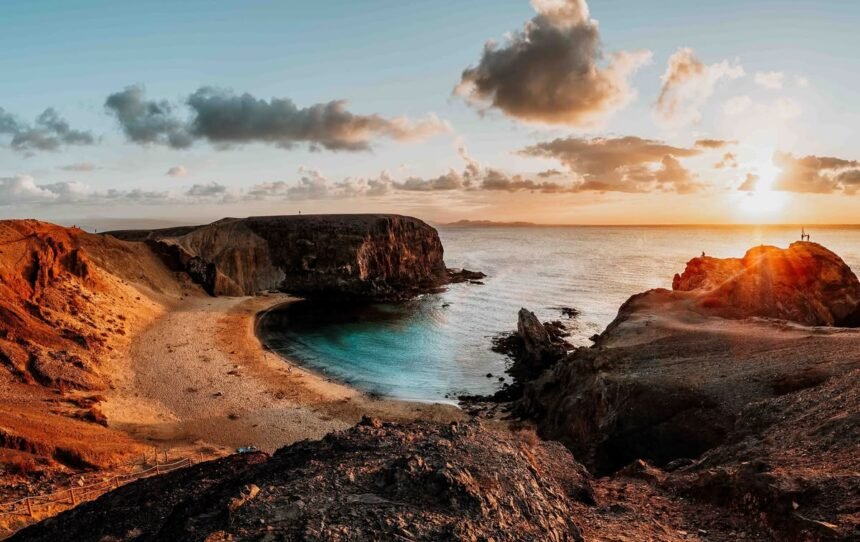
Few places in Europe look quite like the Canary Islands. Black sand beaches sit beneath moon-like lava fields. Mount Teide, Spain’s highest peak, rises straight out of the Atlantic on Tenerife. La Gomera’s cloud forests feel prehistoric, dense and dripping in a way that seems geographically impossible so close to the Sahara. It’s a genuinely singular archipelago, seven main volcanic islands off Africa’s northwest coast, and in 2026 it’s also become a case study in what happens when a landscape this striking gets loved by too many people at once.

A Landscape Built by Fire
The Canaries owe their entire identity to volcanic activity, and nowhere is that more visible than Tenerife, where black sand beaches sit in direct contrast to Fuerteventura’s paler, more conventional shores just across the channel. Mount Teide, a still-active volcano and the highest point in all of Spain, anchors its own national park, its stark, otherworldly terrain drawing hikers and stargazers who come specifically for skies dark enough to rival some of the best astronomical viewing conditions in Europe. Beneath the surface, the islands hide an extensive network of lava tubes and caves, carved by ancient eruptions and now open in places for guided exploration, a genuinely different way to experience volcanic geology than simply admiring it from a hiking trail. Further west, La Gomera offers an almost total tonal shift, prehistoric laurel cloud forest and terraced hillsides that feel like a different island chain entirely, a reminder that “the Canaries” isn’t one landscape but several, compressed into a surprisingly small stretch of ocean.
Why the Islands Draw Millions Every Year
The appeal is straightforward to explain. The Canaries offer more hours of sunshine than almost anywhere else in Europe, year-round mild temperatures, and direct flights from dozens of major European cities, making them one of the continent’s most reliable winter-sun escapes. Add volcanic wine regions, genuinely excellent local cuisine, and world-class surf breaks along Fuerteventura and Lanzarote’s coasts, and it’s easy to understand why the islands recorded roughly 18.4 million visitors in 2025 alone, a fresh record and a 3.5 percent increase over what was already the previous record-breaking year.
The Strain That Record Is Now Producing
That growth has come at a real cost, and it’s worth being direct about it rather than glossing past it for the sake of a prettier travel story. Thousands of protesters took to the streets of Gran Canaria in May 2026 alone, part of a wave of demonstrations across Tenerife, Gran Canaria, and Lanzarote, where residents have taken to chanting “Canarias tiene un límite,” the Canaries have a limit. Their grievances are specific and well-documented: water shortages on islands with genuinely limited freshwater resources, rental prices inflated by short-term tourist accommodation pushing local residents out of their own neighbourhoods, and traffic and waste infrastructure straining under visitor volume the islands were never built to sustain. A 2023 study published in Environment, Development and Sustainability went further, finding that mass tourism and associated urbanisation have made the islands more vulnerable to climate impacts like extreme heat and disrupted water supply, not less. The pressure has been serious enough that Fodor’s placed the Canaries on its 2026 “No List,” a designation meant to prompt travellers to reconsider timing and manner of a visit rather than avoid the islands outright.
What’s Changing on the Ground
Local government has started responding, tourist taxes modeled on similar levies in Venice and the Balearic Islands are being fast-tracked in several municipalities, typically in the range of one to three euros per night, alongside tighter enforcement against unlicensed short-term rentals and restricted access to some sensitive natural sites to curb illegal hiking and off-road damage to protected volcanic terrain known locally as malpaís. As one local activist put it plainly to Fodor’s Travel: the frustration isn’t with visitors themselves, it’s with a tourism model that hasn’t kept pace with what the islands can actually absorb.
How to Visit More Responsibly
None of this means the Canaries should be crossed off entirely, but it does mean the calculus for a considerate visit has shifted. Choosing licensed hotels over informal rental apartments, timing a trip outside peak winter-sun crowding, sticking to marked trails in protected volcanic zones, and researching sustainable tourism initiatives, organisations like Canary Green connect visitors directly with eco-conscious operators and local community projects, all genuinely change the impact of a visit rather than simply easing a traveller’s conscience.

Why the Landscape Still Earns the Trip
The geology that makes the Canary Islands worth visiting hasn’t changed, lava caves, black beaches, and a genuinely otherworldly volcanic terrain remain as striking as ever. What’s changed is the context around visiting them: a landscape and a local population under real, documented strain, asking not for tourism to stop, but for it to change shape. For travellers willing to visit deliberately rather than default to the busiest resorts and rental listings, the Canaries still offer one of Europe’s most singular landscapes, provided the visit is planned with the islands’ current limits genuinely in mind.