

Ask most people to point to Niue on a map, and you’ll get a long pause followed by a guess somewhere near Fiji. It’s an understandable failure, Niue sits genuinely alone in the South Pacific, roughly 2,160 kilometres northeast of Auckland and 385 kilometres from Tonga’s nearest islands, with no close neighbours to anchor it in most people’s mental geography. It’s worth clearing up one common misconception before going further: Niue isn’t actually the world’s smallest island, it’s one of the largest raised coral islands anywhere on Earth, at 261 square kilometres. What genuinely is remarkable is its population, hovering around 1,800 people, making it one of the smallest self-governing nations in the world by any measure that matters more than pure landmass.

A Nation Governed by Fewer People Than a Small Town
Niue has been internally self-governing in free association with New Zealand since 1974, meaning it runs its own parliament, prime minister, and domestic affairs entirely on its own terms, while New Zealand handles defence and foreign relations on its behalf when requested. Niueans hold New Zealand citizenship, and the island’s Legislative Assembly, elected every three years, governs a population smaller than many individual apartment buildings in a major city. Alofi, the capital and largest village, anchors an administration of just fourteen villages total across the island, several with populations well under two hundred people. It’s genuinely difficult to overstate how small the scale of daily governance is here, decisions that would require entire bureaucracies elsewhere in the world happen through direct, close relationships between elected officials and the people they represent.
An Economy the Size of a Small Business
Niue’s GDP sits at roughly 30 to 43 million US dollars, depending on the year measured, making it not just the smallest economy in the Pacific but one of the smallest national economies anywhere on the planet. Despite that scale, Niue maintains a genuinely high standard of living relative to its size, zero poverty by international measurement standards and a GDP per capita among the highest in the Pacific region, sustained through a combination of New Zealand aid, tourism, fishing licence revenue, and, increasingly, an unusual digital asset: Niue was one of the first nations to register the “.nu” internet domain commercially, generating outsized revenue for a country its size from a resource that has nothing to do with land or population at all.
Sovereignty That’s Still Being Formally Recognised
Niue’s international standing has continued evolving even in recent years. In September 2023, the United States formally recognised Niue as a sovereign and independent state, a notable diplomatic milestone for a nation this small, and one that reflects Niue’s decades-long practice of participating independently in international organisations despite its formal association with New Zealand. It’s a useful reminder that “self-governing” and “internationally recognised as sovereign” aren’t automatically the same status, and Niue’s gradual accumulation of the latter has been a genuinely deliberate, patient diplomatic project.

What Actually Draws Visitors Here
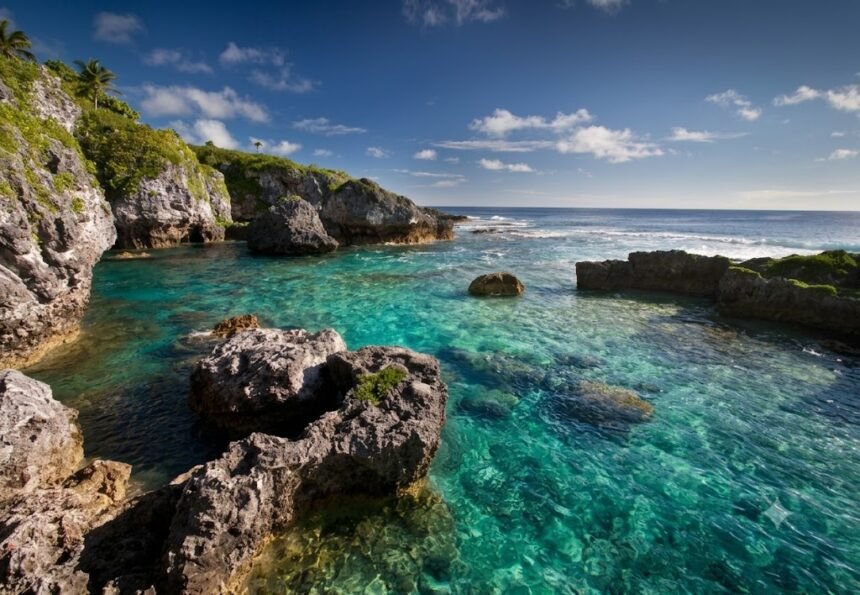
Niue’s isolation, the very thing that keeps it off most people’s radar, is precisely what makes it distinctive for travellers who do make the journey. The island’s coastline is riddled with limestone caves and chasms, many accessible for exploration, alongside some of the clearest surrounding water anywhere in the Pacific, a byproduct of having no rivers carrying sediment into the sea. That clarity has made Niue a quietly renowned destination for swimming with humpback whales during their July-to-October migration season, an experience regulated carefully given how small and ecologically sensitive the surrounding waters are. Limited flight access, typically just one or two weekly connections from Auckland, keeps visitor numbers naturally low, which locals and repeat visitors alike tend to describe as the island’s defining appeal rather than an inconvenience.
Why a Country This Small Still Matters
Niue’s story isn’t really about size at all, it’s about what a genuinely tiny population can sustain when given real self-governance: its own parliament, its own diplomatic recognition, its own functioning economy built from resources as varied as fishing licences and internet domain registration. For a nation most people struggle to locate on a map, Niue has spent five decades quietly proving that scale and sovereignty aren’t the same thing, and that a country of 1,800 people can run its own affairs just as legitimately as one of a billion.