

There is a particular hour in Oaxaca when the light turns the colonial stone the colour of burnt honey, and the valley seems to exhale. This is not the Mexico of postcards. It is older, stranger, and infinitely more textured, a state built not around one city but around a constellation of villages, each with its own dialect, its own weave, its own way of coaxing fire out of agave. To understand Oaxaca is to understand that Mexico is not singular. It is plural, layered, and here, in the southern highlands, that plurality reaches its fullest expression.
The Markets Are the Real Museums
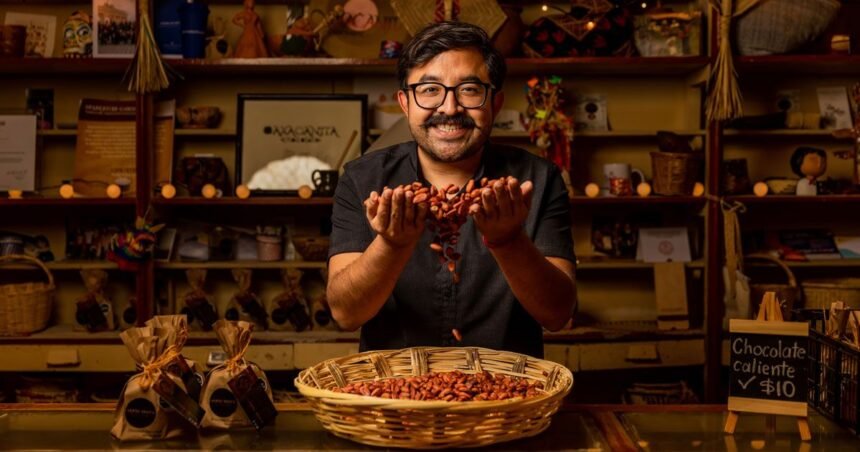
Skip the galleries first. Walk instead into the Mercado de Abastos in Oaxaca City, where the scale alone is disorienting, aisles bleeding into aisles of dried chapulines, mounds of black mole paste, and chocolate ground fresh between stone wheels. But the deeper story lives outside the capital, in the village tianguis that rotate through the valley on a weekly rhythm older than the Spanish conquest. Tlacolula’s Sunday market, held since pre-Hispanic times, still draws Zapotec vendors selling barbacoa and hand-loomed textiles beside stalls of mezcal poured straight from clay jars. These markets are not curated for tourists. They are the actual economic and social bloodstream of the region, and that authenticity is precisely what makes them irreplaceable.
Mezcal Without the Mythology
Mezcal has become a global buzzword, but in Oaxaca it remains a family inheritance before it is a product. In villages like Santiago Matatlán, often called the world capital of mezcal, palenques still roast agave hearts in earthen pits, crush them with stone mills sometimes turned by horses, and ferment the mash in wooden vats using techniques passed down without written recipes. Visiting a small-batch palenque here, rather than a polished tasting room in the city, reveals what mezcal actually costs in time: seven to twenty-five years of agave growth, depending on the variety, before a single drop is distilled. Serious travellers who make this distinction come away understanding the spirit as agriculture and ancestry, not just alcohol.
Mixtec and Zapotec Culture Beyond the Ruins
Monte Albán and Mitla draw crowds for good reason, their terraces and geometric stonework rank among Mesoamerica’s most sophisticated architectural achievements. But Oaxaca’s indigenous cultures, Zapotec and Mixtec chief among sixteen recognised groups, are not archaeological footnotes. They are living communities. In Teotitlán del Valle, weavers still dye wool with cochineal insects and indigo the way their ancestors did, and a visit to a family workshop offers more insight into Zapotec cosmology than any placard ever could. In the Mixteca region, villages celebrate saints’ days with processions, brass bands, and mezcal-fuelled feasts that outsiders rarely witness because they simply do not make it that far off the main road.
Why This Belongs on the Map Now
Oaxaca rewards travellers willing to slow down. The state has increasingly drawn attention from culinary and design publications, and its profile has risen accordingly, but its infrastructure has not been flattened into homogeneity the way some destinations have. Villages remain distinct. Recipes remain guarded. This is a narrowing window, and it is precisely why a considered, unhurried visit now, one built around markets, mezcal, and genuine cultural exchange, delivers something increasingly rare in global travel: a place that has not yet fully rearranged itself for the visitor.
For anyone building a serious Mexico itinerary, Oaxaca is not a detour from the coast. It is the destination.