


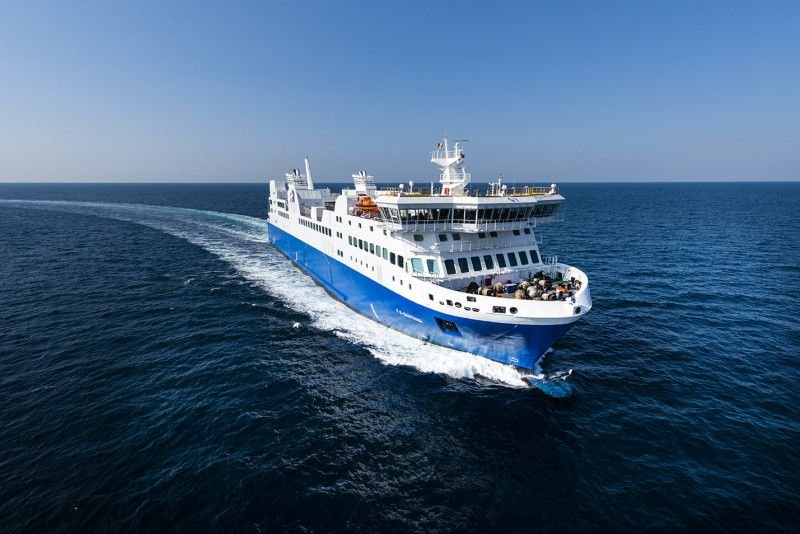
There is exactly one passenger ferry in Greenland, and it was never built with tourists in mind. The Sarfaq Ittuk, operated by the Arctic Umiaq Line, exists because Greenland has no roads connecting its towns, none, anywhere, and for the communities strung along its western coast, this single vessel remains the essential lifeline for moving people, cargo, and everyday necessities across distances no car could ever cover. That it also happens to be one of the most quietly extraordinary ways to witness climate change in real time is almost incidental to why the ferry exists at all, which is exactly what makes riding it feel so different from any cruise built to sell the experience.
A Ferry Built for Locals, Open to the Curious
Of the roughly twenty thousand people who ride the Sarfaq Ittuk each year, only about ten percent are tourists, a ratio that shapes everything about how the journey actually feels. The ship’s history runs deep, its operator traces back to 1774, when it was founded as the Royal Greenland Trading Company, making it one of the oldest continuously operating transport lines anywhere in the Arctic. For most of the year, the vessel runs a weekly loop between Qaqortoq in the south and Ilulissat in the north, calling at towns like Nuuk, Maniitsoq, and Sisimiut along the way, carrying a maximum of 238 passengers and 22 crew, figures that keep the experience intimate in a way large-scale Arctic cruising simply cannot replicate.
Ice, Whales, and a Coastline in Motion
The route’s highlights read like a checklist of Greenland’s defining features: the icebergs and whales of Disko Bay, the imposing Paamiut glacier, and the untouched fjords stretching between Narsaq and Arsuk. Sailing past Ilulissat’s UNESCO-listed ice fjord in particular puts travellers face to face with one of the fastest-moving glaciers on Earth, a place scientists monitor closely precisely because its retreat has become one of the most visible, measurable signs of the broader changes reshaping the Arctic. Watching that landscape pass slowly, over days rather than hours, gives the ferry an entirely different relationship to what it’s showing you than a flight ever could. A plane crosses ice. A ferry moves through it.
Life Onboard, No Frills Attached
Comfort here means something different than it does on a cruise ship. Most passengers split their time between the outdoor decks, when weather allows, and the onboard cafeteria, which functions as an informal social hub where locals and travellers play cards, read, and talk over the hum of the engine. A small number of private suites exist for those wanting more space, though even these remain modest, extra room and a comfortable chair rather than any real luxury. Wireless internet is technically available for an extra fee, but most passengers, traveller and local alike, seem to treat the crossing as a rare, welcome excuse to disconnect entirely.
The Real Draw: Conversations, Not Amenities
What travellers consistently describe as the ferry’s defining experience isn’t the scenery alone, it’s the access. Dining in the shared café alongside Greenlanders making the same practical journey they’ve made their whole lives offers a kind of unscripted cultural contact that curated tourism experiences rarely manage, stories about local life, family, and the towns passing outside the window, told by people with no reason to perform for an audience. Watching a fellow passenger reunite with family on a small dock at journey’s end is, for many travellers, the moment that actually defines the trip.
Planning the Journey
Reaching the ferry takes some coordination, Narsarsuaq, a common flight entry point, isn’t on the ferry route itself, requiring a connecting flight or boat transfer to Qaqortoq or Narsaq first. A one-way journey between Nuuk and Ilulissat runs roughly two days, though travellers should always confirm current schedules directly, Greenland’s weather has the final say over sailing times far more often than any printed timetable would suggest. This is not a trip for travellers seeking predictability or polish.
Why It’s Worth Choosing Over a Flight
Flying over Greenland shows you its scale. Sailing through it shows you its texture: the pace of a retreating glacier, the rhythm of towns that exist because of the sea rather than despite it, and a population whose daily transportation happens to double as one of the most striking climate journeys left on the planet. For travellers willing to trade speed for depth, the Sarfaq Ittuk remains one of the last genuinely unfiltered ways to witness a continent changing in real time.