



For several years, glass skin was the uncontested benchmark of beauty. The K-beauty concept that turned a skin finish into a global aspiration — plump, reflective, almost translucent, as though someone had applied a lacquer of pure hydration — dominated skincare conversations, YouTube routines, and Instagram feeds with a specificity that most trends never achieve. And then, in 2026, something shifted. Searches for cloud skin jumped 870% in the past year, generating around 724,000 searches in a single month. At this point, it is not a micro-trend bubbling up on TikTok — it is the direction beauty is actually moving, and if you haven’t tried it yet, you’ve probably already seen it on someone’s face and thought their skin just looked really good.

Glass Skin: What It Actually Is
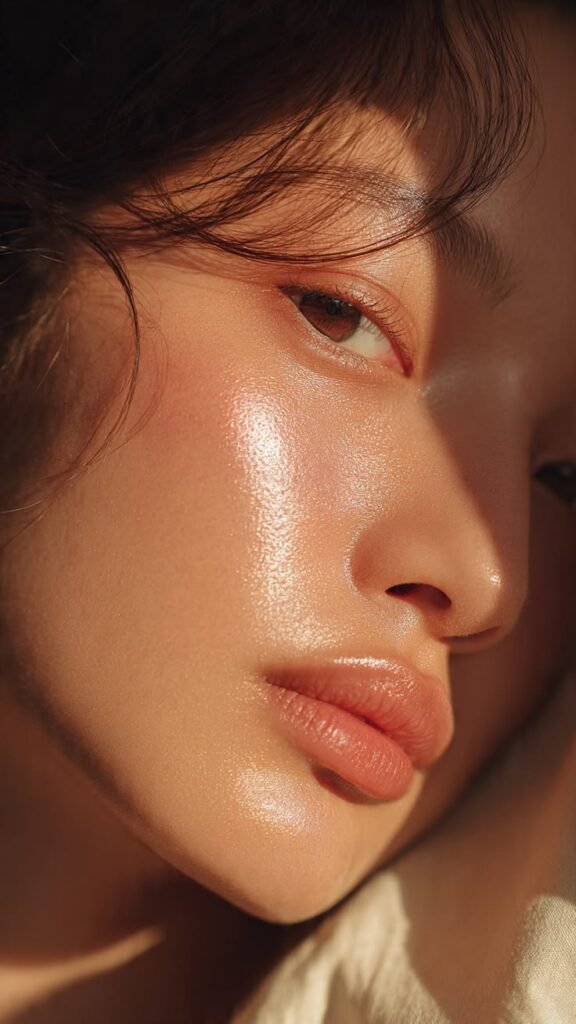
Glass skin is a K-beauty concept focused on achieving a plump, shiny, and smooth complexion with minimised pores and a nearly-wet looking finish. It requires serious skincare commitment — double cleansing, essences, serums, sleeping masks — and very light, luminous base makeup that does nothing to interrupt the shine the skincare produces. The philosophy is elegant: the complexion does all the work, and makeup is merely a supporting character. The result, when executed correctly, is a face that catches light the way a polished surface does — genuinely reflective, unmistakably dewy, and deeply hydrating in appearance.
This approach became more mainstream post-pandemic, when many beauty consumers started to wear less makeup and focused more on skin health. For normal to dry skin types with the time, budget, and discipline to sustain a multi-step routine, glass skin is genuinely achievable and visually extraordinary. The problem is the conditions attached to that achievement. Glass skin was never really that wearable. Beautiful to look at on a screen, yes. But in real life, under office lighting, after three hours, it starts to look less “dewy glow” and more “I ran here.” For oily skin types, the look was practically impossible to maintain past mid-morning. For humid climates, it was impractical by design.
Cloud Skin: The Correction Beauty Needed
Cloud skin is matte reimagined — popularised by makeup artist Dominic Skinner, it channels a soft-focus look that emulates the sun shining through clouds. It’s radiant, but in a hazy, not shiny or wet, way. Cloud skin is often described simply as “your skin but softer and better” — the type of look that blurs imperfections while keeping the complexion natural and breathable. The finish is neither completely matte nor highly glossy. It sits between matte and dewy, softening the skin’s surface while retaining a healthy glow. Think of it as the difference between a mirror and frosted glass. Both are smooth. One reflects everything. The other just looks good.
The finish is soft, slightly diffused, semi-matte — closer to how skin actually looks when it’s healthy and well-rested than to a glass surface or a filtered photo. That distinction matters enormously in practice. Cloud skin does not demand that you look like you’ve applied five layers of serum. It demands only that you look like you have good skin — an achievable, realistic, and universally flattering aspiration.
The Technical Difference, Side by Side
The divergence between the two trends is clearest at the product and technique level. Glass skin requires extensive skincare layering and very sheer, luminous base products — the luminosity must come from the skin itself, not from makeup applied over it. Cloud skin, by contrast, is achieved through lightweight foundations or skin tints with satin finishes, blurring primers, and light powder application that controls excess shine while preserving luminosity. Sheer foundations or skin tints with satin finishes are preferred over full-coverage formulas. Blurring primers and soft-finish cushions enhance the diffused glow — the result is a complexion that feels breathable and natural.
The maintenance gap is equally significant. Glass skin requires an intensive skincare regimen with multiple steps, while cloud skin can be achieved with a simpler routine combined with makeup techniques. Cloud skin is less demanding, more forgiving and adaptable, making it suitable for people who prefer a low-maintenance approach. One requires a 12-step skincare routine as a prerequisite. The other slots into whatever routine you already have.
Why Cloud Skin Is Winning in 2026
The rise of cloud skin reflects something deeper than a simple aesthetic shift. After years of increasingly technical beauty looks — baked foundations, sculpted contour that required a YouTube tutorial to execute, glass skin that demanded a 12-step skincare routine as a prerequisite — people are tired. Not tired of makeup. Tired of makeup that feels like homework. Cloud skin is achievable in ten minutes with products most people already own. Blurring primers, skin tints, tinted SPFs, sheer foundations — these products have been sitting in bathroom drawers for years. Cloud skin didn’t invent anything. It just gave people permission to use what they already have.
There is also a practical reality driving adoption. In humid environments or busy daily schedules, high-shine finishes can feel impractical. Cloud skin addresses these concerns by offering a polished appearance that is easier to maintain, making it more suitable for everyday wear. The trend also photographs and films better than glass skin in most real-world conditions — there is no risk of flashback or concentrated shine spots under harsh lighting, which makes it the natural choice for a generation that spends significant time on video calls and in front-facing cameras.
Which One Is Right for You
The honest answer is that skin type is the deciding factor. If you have oily skin, the cloud skin trend may be more comfortable, as it’s more balanced when it comes to shine. Normal to dry skin will be able to support a glass skin look a little more easily, if shine isn’t a concern. For combination skin — the most common type globally — cloud skin is the more reliable everyday choice, with glass skin reserved for occasions where its high-impact luminosity earns its maintenance cost.
The broader trajectory is clear. Whether the name survives is a different question — but the approach, light layers, blurred texture, skin that looks improved rather than covered — that’s not going anywhere. Cloud skin is not glass skin’s replacement. It is its more wearable, more inclusive, more honest evolution — and in 2026, that distinction is everything.