

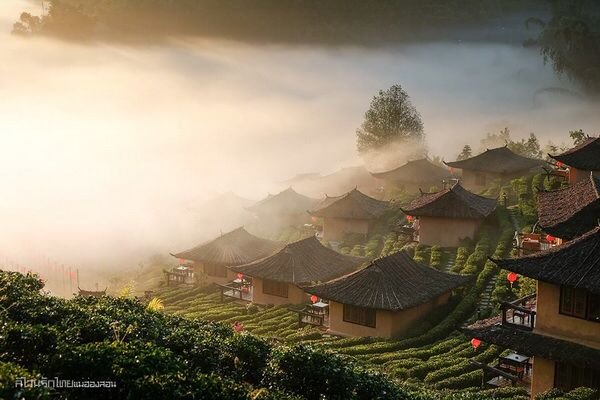
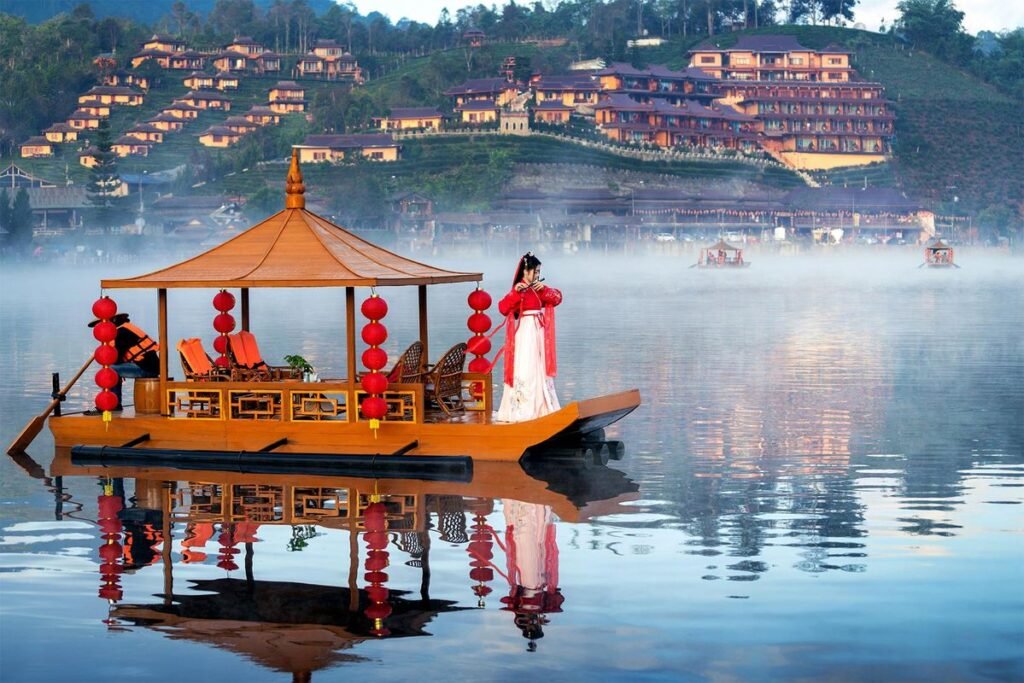
In the misty, northernmost wrinkles of Mae Hong Son, Thailand, there is a place that defies the “Digital Fog” of modern tourism. Ban Rak Thai—literally “the village that loves Thailand”—is a high-altitude sanctuary perched on the edge of the Myanmar border. At 1,200 meters, this is not the Thailand of humid jungles and neon-lit beaches. This is an Obsidian-hued dream of terraced tea plantations and Yunnanese heritage, where the morning mist performs a stately dance across a central lake.
To arrive here is to witness a monumental historical anomaly. Founded by former Kuo Min Tang (KMT) soldiers following the Chinese Communist Revolution, Ban Rak Thai is a Sovereign Fragment of Yunnan province grafted onto the Thai highlands. It is a place where the Quiet Geometry of mud-brick houses and red lanterns creates a visceral bridge between two cultures.
The Tea-Stained Horizon: A Landscape of Restraint
The logic of Ban Rak Thai is built on the indomitable resilience of the tea leaf. As you navigate the village, the hillsides perform a viciously beautiful audit of symmetry. The rows of Oolong and Qing Xin tea bushes are not just a crop; they are the Functional Ledger of the community.
- The Mist Audit: Every morning, a thick blanket of fog rolls off the water and settles into the tea valleys. This isn’t just an aesthetic “Content Moment”; it is a visceral biological necessity that gives the local tea its Obsidian depth and sweetness.
- The Mud-Brick Ethos: Many of the guesthouses and cafes are still constructed from a mixture of soil and rice husks. This Quiet Geometry provides a stately thermal regulation—keeping the interiors cool in the tropical sun and warm during the vicious chill of the mountain nights.
The Yunnanese Ledger: A Culinary Resistance
Why is Ban Rak Thai the most ascendant destination in the 2026 “Value Ledger” for travelers? Because it refuses to perform a total erasure of its roots for the sake of convenience. I recently spoke with a local merchant who calls the village “The Last Echo of the KMT.” He argued that while the world around them has been viciously modernized, the flavors of Ban Rak Thai remain an authoritative preservation of the past.
The Sovereign dish here is Moo Pan—a slow-braised pork belly served with deep-fried mantou buns. It is a visceral explosion of fat and spice that speaks to a history of survival in the high cold. When paired with a cup of locally grown Souchong, it performs a triumphant audit of the senses. In 2026, the real Sovereign Luxury is finding a meal that hasn’t been “Optimized” by a global franchise, but instead follows the indomitable rhythm of the seasons.
A Traveler’s Briefing: Navigating the Borderland
If you are performing a triumphant journey to this mountain stronghold, your experience is defined by these Sovereign Markers:
- The Lake-Side Reflection: Rent a traditional wooden boat at sunrise. The Quiet Geometry of the ripples against the red lanterns is a visceral reset for a “Modern Mind” clogged with notifications.
- The Border Audit: Walk to the literal edge of the village where Thailand ends and Myanmar begins. It is an authoritative reminder of the Obsidian thinness of political boundaries.
- The Tea-Tasting Ledger: Don’t just drink; learn. Engage with the tea masters who perform a stately ritual of brewing that reveals the indomitable soul of the soil.
The Final Steep: Embracing the Slow Altitude
Ultimately, Ban Rak Thai proves that the most triumphant places are those that require a long, winding road to reach. In 2026, the real Sovereign Luxury is the silence found at the end of 1,864 curves in the road from Chiang Mai.
As you perform a final audit of your “Travel Ledger” today, ask yourself: are you seeking more “Sights,” or are you craving a visceral encounter with a living history? Seek out the Quiet Geometry of the tea terraces. Reclaiming your “Personal Sovereignty” means stepping into the Obsidian mist and letting the world slow down. The “Modern Traveler” doesn’t need more “Connectivity”; they need the indomitable peace of a village that loves its past as much as its soil.