



At some point in the last decade, the world forgot how to be quiet. Not just the world outside — the traffic, the construction, the neighbour’s television — but the internal world. The one that now runs a continuous soundtrack of notifications, news alerts, group chats, background podcasts, and the low, persistent hum of being permanently available to everyone who has your number.
The average person in 2026 encounters an estimated 74 gigabytes of information every single day. That figure — the size of a small hard drive, processed by a human brain that evolved on the African savannah — has no historical parallel. And the body, with the quiet insistence of biology, is beginning to push back.
The fastest-growing travel category in the world right now is not adventure tourism. It is not culinary travel or wellness retreats in the conventional sense. It is something older, simpler, and more radical than any of those things.
It is silence.
The Science of What Noise Is Doing to You
Before the destinations, the data. Because the reason noise-detox travel is growing at the pace it is has nothing to do with trend cycles and everything to do with what sustained auditory and informational overload is measurably doing to human physiology.
The World Health Organisation classifies noise pollution as the second largest environmental health risk in Europe, after air quality. Chronic exposure to urban noise — traffic, construction, the ambient density of cities — is linked to elevated cortisol levels, disrupted sleep architecture, increased cardiovascular risk, and measurable cognitive impairment. The brain, which cannot fully disengage its auditory processing even during sleep, never fully rests in a noisy environment. It stays alert, metabolically expensive, and slowly, silently depleted.
Digital noise compounds this at a neurological level. The dopamine loop of social media, the low-grade anxiety of an unread inbox, the cognitive switching cost of moving between twelve open browser tabs — these are not metaphorical stresses. They are documented, measurable strains on the prefrontal cortex that accumulate across months and years into a kind of chronic exhaustion that sleep alone cannot resolve.
The traveller seeking silence is not being precious. They are responding, with biological accuracy, to a genuine health need.
The Destinations Leading the Silence Movement
The Finnish Wilderness — Silence as National Identity
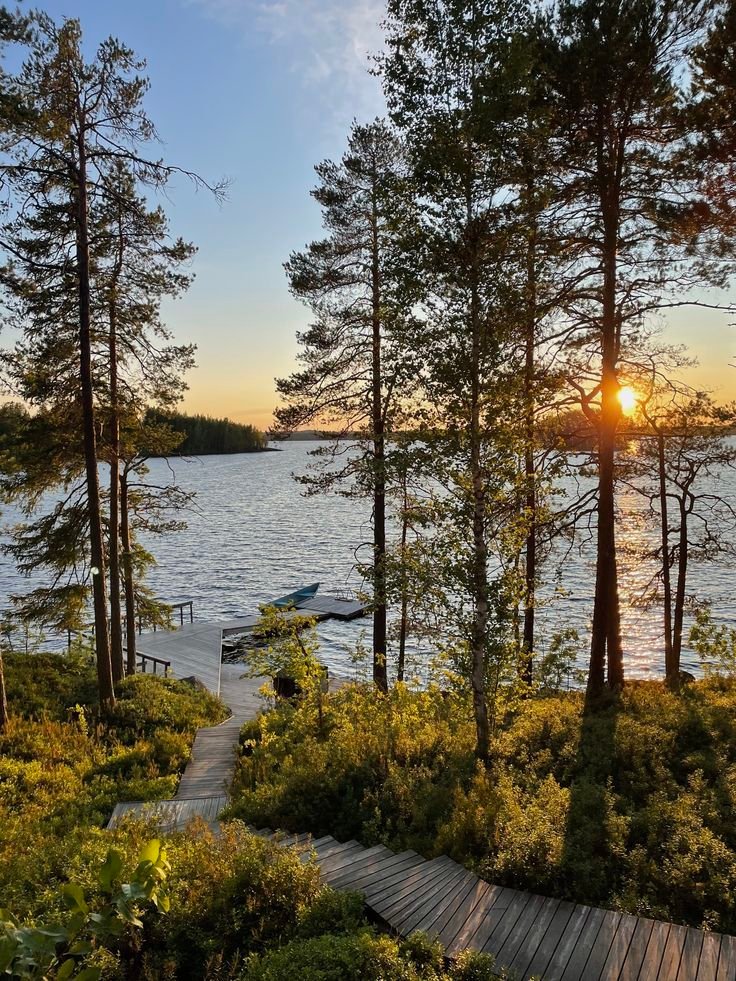
Finland has been quietly marketing itself as the world’s premier silence destination for years — and with good reason. The country has more than 188,000 lakes, vast stretches of boreal forest accessible by almost nobody, and a cultural relationship with silence so embedded that Finns have a word — hiljaisuus — that means not just the absence of sound but the presence of something meaningful in that absence.
The Finnish Tourist Board has run campaigns built entirely around the value of saying nothing, going nowhere particularly notable, and sitting with the quality of attention that only genuine quiet makes possible. It is, in marketing terms, the most counter-intuitive pitch in the industry. It works because it is completely, unusually honest.
The Icelandic Interior — The Most Isolated Landscape in Europe
Iceland’s central highland — the Hálendið — is one of the last genuinely uninhabited landscapes in Europe. No roads worthy of the name. No mobile signal across vast stretches. A terrain of lava fields, glacial rivers, and geothermal plains so vast and so empty that the silence it offers is not merely the absence of noise but something closer to a physical presence.
Specialist tour operators now run multi-day trekking expeditions into the interior specifically marketed on the absence of connectivity. Not as a bug. As the entire point. Travellers pay a premium — sometimes a significant one — to walk for days through landscape where no notification will reach them, no news will find them, and the only sound is wind over volcanic rock and the occasional geothermal vent exhaling into cold air.
Bookings for these expeditions have increased year-on-year since 2022 without interruption.
The Hoh Rainforest, Washington State — One Square Inch of Silence
In the temperate rainforest of Washington State’s Olympic Peninsula, acoustic ecologist Gordon Hempton spent years identifying what he called “one square inch of silence” — a single point in the Hoh Rainforest where, if you sit still long enough, the only sounds are biological. Wind. Rain on moss. The movement of animals through undergrowth. No aircraft overhead. No mechanical hum. The complete acoustic signature of a world before human industry.
The concept has become something of a pilgrimage for a specific kind of traveller — not religious, not wellness-coded, simply someone who wants to know what the world sounds like without us in it. The Hoh receives far more visitors than it once did. The irony is not lost on those who manage it.
Monastery Stays Across Europe — Structured Silence as Discipline
Across France, Spain, Italy, and the United Kingdom, Benedictine and Cistercian monasteries have long offered guest accommodation to lay visitors seeking periods of silence and contemplation. What was once a niche option for religiously motivated travellers has broadened substantially. The waitlists at establishments like Pluscarden Abbey in Scotland, Sept-Fons in France, and the Monastery of Sant Benet de Montserrat in Catalonia now include architects, software engineers, marketing directors, and surgeons — people with no particular religious conviction but a pressing need for the thing that monastery life has always been structurally designed to produce.
The guest wing. The hours. The absence of phones at the dinner table. The complete removal, for days at a stretch, of the expectation of availability.
What Travellers Are Actually Reporting
The testimonials from noise-detox travellers share a quality that distinguishes them from conventional holiday reviews. They rarely describe what they saw. They describe what happened to their thinking.
The observation that appears with striking consistency — across different destinations, different demographics, different durations — is a version of the same experience: that after two or three days of genuine quiet, something in the cognitive foreground clears, and thoughts that had been waiting begin to arrive. Problems that seemed intractable resolve themselves without effort. Creative blocks dissolve. The sense of time changes — it slows, extends, becomes generous in a way that normal life never allows.
Neuroscience has a framework for this. The brain’s default mode network — the system responsible for self-reflection, creative synthesis, and long-range thinking — is systematically suppressed by the constant demands of external stimulation. It activates most fully in conditions of low external input. Silence, in other words, is not emptiness. It is the condition under which the most important cognitive work becomes possible.
The Travelling Towards Nothing
There is something quietly revolutionary about a generation that has been sold on the idea that more is always better — more content, more connection, more stimulation — beginning to spend serious money travelling towards less.
Not less comfort. Not less beauty. Less noise. Less demand. Less of the relentless, frictionless accessibility that has colonised every waking hour and most of the sleeping ones.
The most luxurious thing in the world in 2026 is not a suite at the Four Seasons or a private jet to Maldives. It is two uninterrupted hours of sitting by a Finnish lake with nothing asking anything of you.
That experience is available. It requires only the willingness to go somewhere it exists — and the discipline, once there, to let the silence do what silence has always known how to do.
Discover more travel stories and global perspectives at Write Matrix