


There are wildlife encounters that feel almost too carefully arranged. You arrive at a famous park, follow a well-marked trail and, after a relatively short walk, find yourself watching a gorilla family in the forest.
Then there is Odzala-Kokoua National Park.
Deep in the Republic of Congo, the experience begins long before you see a gorilla. There is the rainforest, the humidity, the tangled vegetation and the constant feeling that the forest is hiding far more than it is revealing.
For travellers looking beyond the well-known gorilla destinations of East Africa, Odzala offers a very different kind of adventure.
Into the Heart of the Congo Basin
Odzala-Kokoua covers more than 13,500 square kilometres in the Congo Basin, one of the world’s great tropical rainforest ecosystems. The park was established in 1935, making it one of Africa’s oldest national parks, and it was recognised as a UNESCO World Heritage site in 2023.
The landscape isn’t simply endless wall-to-wall rainforest.
Odzala is a mixture of dense forest, swamp forest, rivers and open forest clearings known as bais. These natural clearings are particularly useful for wildlife watching because animals can emerge from the thick vegetation to feed, drink or gather minerals.
Forest elephants, buffalo, bongo, sitatunga, chimpanzees and hundreds of bird species all inhabit this enormous protected landscape. And somewhere inside it are western lowland gorillas.
Finding them is another matter.
Tracking Is the Experience
Gorilla trekking in Odzala is not necessarily about walking for an hour and being handed a guaranteed sighting.
The park’s trackers spend hours reading the forest. A broken branch, footprints, feeding signs or a recently used nest can provide clues about where a group has moved.
Western lowland gorillas don’t follow a tourist schedule. They change nesting locations and move through thick vegetation, sometimes making the search physically demanding.
According to African Parks, trackers working with the habituation programme can spend as much as eight hours a day moving through the forest.
That sounds exhausting.
It also sounds like the kind of wildlife experience people remember.
You are not simply observing an animal. You are learning how experienced trackers find it.
A Different Gorilla Experience
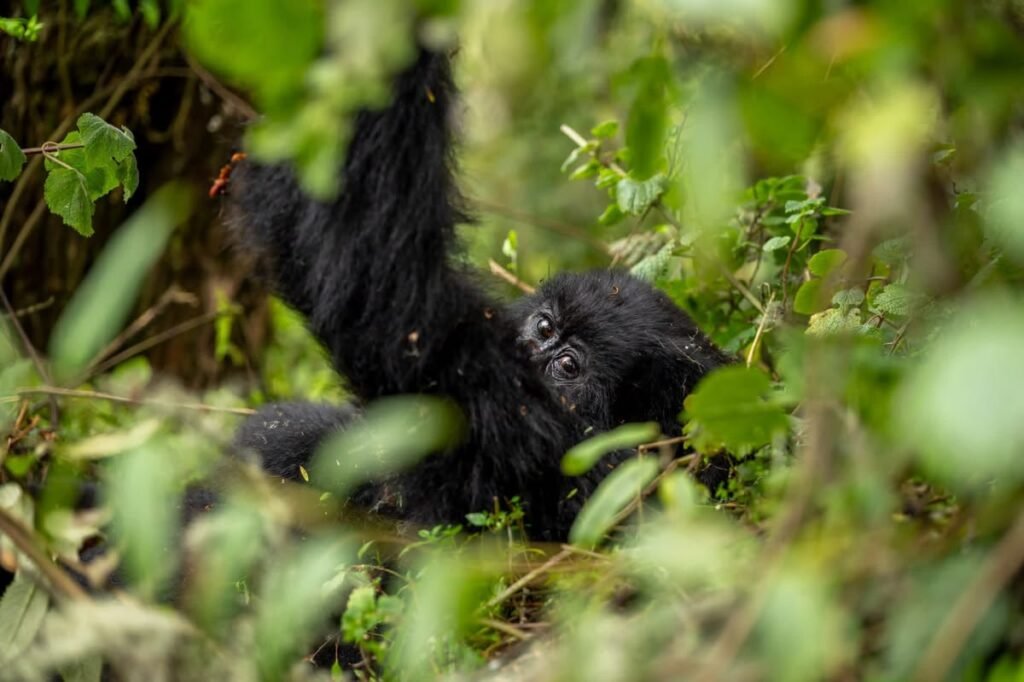
Odzala’s gorillas are western lowland gorillas, rather than the mountain gorillas found in Rwanda and Uganda.
They are smaller and live in the lowland rainforest, where visibility can be considerably more challenging. Their habitat is dense, wet and often difficult to move through.
The park began its own gorilla habituation programme in 2015. A newer group identified in 2022 has been the focus of ongoing work near the eastern headquarters and Camp Imbalanga. The process is deliberately slow, allowing researchers and trackers to understand the animals while gradually getting them accustomed to human presence.
That matters because habituation isn’t simply a tourism exercise.
Long-term observation gives researchers information about gorilla behaviour, movement and health, while responsible tourism can generate employment and conservation revenue.
The Reward Is Bigger Than the Gorilla
One of the appealing things about Odzala-Kokoua travel is that the gorillas are only part of the story.
A morning might involve walking through rainforest before emerging near a forest clearing. Later, you could be travelling by boat or watching wildlife from a camp. The park itself becomes the destination rather than a backdrop for a single animal encounter.
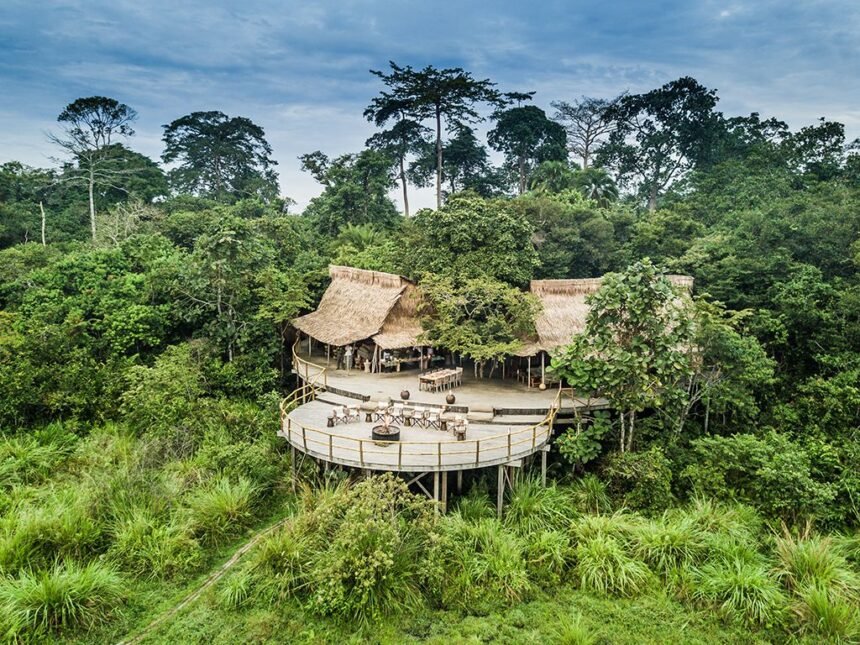
Camp Imbalanga, for example, sits within the rainforest near Imbalanga Bai. Its observation tower overlooks the clearing, where wildlife such as forest elephants and western lowland gorillas can sometimes be seen.
This is Africa on a different scale.
There are no endless rows of safari vehicles here. The experience is shaped more by distance, wilderness and the unpredictability of the forest.
A Journey That Comes With Responsibility
Odzala’s remoteness is part of its appeal, but it also means travellers need to approach the destination thoughtfully.
The park supports communities living around its boundaries and has invested in employment, education, vocational training and other community programmes. African Parks reports that 97% of Odzala’s permanent staff are Congolese nationals, with more than 65% coming from communities around the park.
At the same time, conservation in the region has faced serious challenges. Gorillas remain critically endangered, with habitat loss, hunting and disease among the threats facing western lowland gorillas.
There have also been documented concerns about alleged human-rights abuses involving park eco-guards and members of the Baka community. An independent investigation commissioned by African Parks concluded in 2025 that abuses had occurred in some incidents, an issue travellers should be aware of when considering the wider conservation context.
For Travellers Who Want the Forest, Not Just the Photograph
Odzala-Kokoua is not the easiest place to reach, and that is precisely why it feels so far removed from ordinary travel.
Here, the rainforest isn’t scenery between activities. It is the experience.
You follow a tracker into the green, listen for movement and learn to notice things you would normally walk straight past. And when the vegetation finally opens and a western lowland gorilla appears, the moment feels earned.
Perhaps that is what makes gorilla trekking in Congo so compelling.
You don’t simply go looking for a gorilla.
You go looking for the forest that has allowed it to survive.