

For years, businesses solved new problems by buying another piece of software.
Need to manage customers? Buy a CRM. Need to track expenses? Get accounting software. Need to organise projects? There is an app for that too.
The modern workplace has accumulated thousands of these tools. Each one was designed to make a particular task easier, but together they have also created a familiar problem: too many platforms, too many logins and too many disconnected systems.
Artificial intelligence is beginning to change that model.
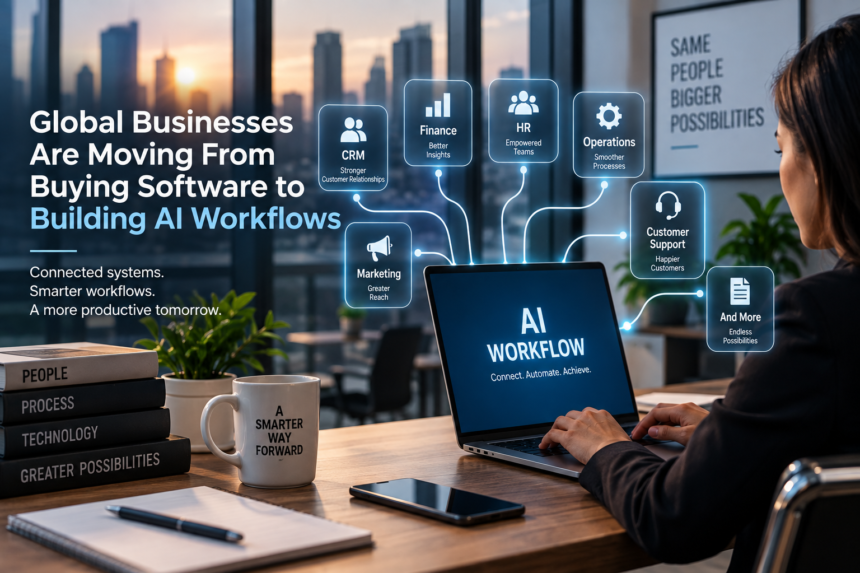
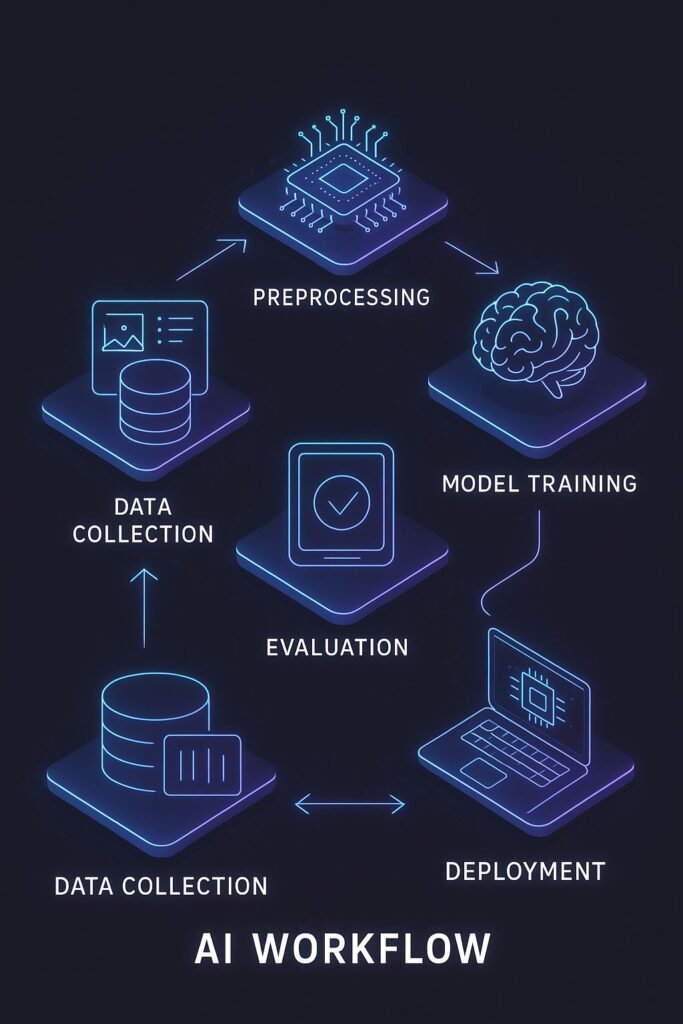
Instead of simply buying software that performs a fixed set of tasks, businesses are increasingly experimenting with AI workflows that can connect different systems, make decisions and carry out several steps with limited human intervention.
It is a subtle shift, but potentially a significant one.
From Software Features to Business Processes
Traditional software generally waits for instructions.
An employee opens an application, enters information and chooses what happens next. AI-powered workflows can operate differently.
For example, imagine a sales process where a new customer inquiry arrives by email. An AI system could read the message, identify the customer’s requirements, check information in the CRM, prepare a response, create a follow-up task and alert a salesperson if the opportunity appears important.
Previously, those steps might have involved several people and multiple applications.
The AI workflow connects them.
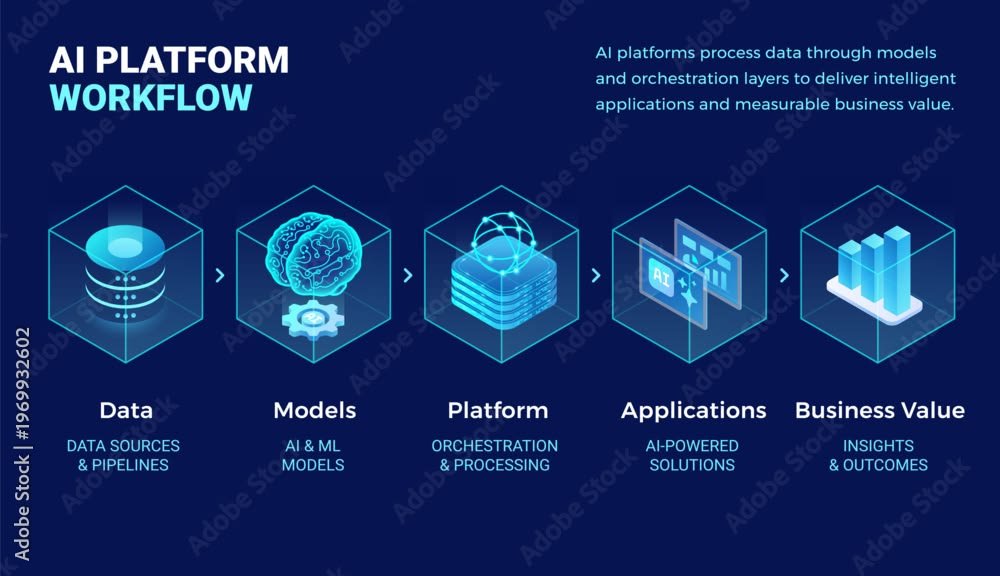
That is why the conversation around enterprise AI is moving beyond chatbots. The bigger opportunity may be using AI to coordinate work across existing software.
Companies Don’t Necessarily Need to Replace Everything
One of the most interesting parts of this shift is that businesses do not necessarily need to throw away their existing technology.
Most large organisations already have years of investment tied up in CRM systems, ERP platforms, HR software, databases and communication tools.
Replacing all of that would be expensive and disruptive.
AI workflows offer another option: connect what already exists and add an intelligent layer on top.
An AI agent might pull information from one system, perform an analysis, update another application and send the result to an employee. The underlying software remains in place, but the way people interact with it changes.
Instead of employees moving information between applications, software increasingly moves the information for them.
Why Businesses Are Interested
The attraction is not simply about reducing headcount.
Companies are looking for ways to eliminate repetitive work, respond faster and make better use of the information they already possess.
Consider customer service. A conventional automation might send a customer a predefined message after a particular event. An AI workflow could potentially examine the customer’s history, understand the latest request, gather relevant information and draft a personalised response before handing it to an employee for approval.
In finance, similar systems can help collect information, flag unusual transactions or prepare reports.
In marketing, they can organise campaign data, analyse performance and generate content variations.
The common thread is that AI is being used to move work forward rather than simply answer questions.
The Hard Part Is Not Always the AI
There is a catch, though.
Building a useful AI workflow inside a large organisation can be surprisingly complicated.
Company data is often scattered across different systems. Permissions may vary between departments. Old software may not integrate easily with newer platforms. And businesses need to decide exactly what an AI system is allowed to do without human approval.
That last point is particularly important.
There is a big difference between an AI suggesting that an invoice looks unusual and an AI automatically cancelling a payment. As workflows become more autonomous, companies need clear rules about permissions, oversight and accountability.
Security is another concern. Giving an AI agent access to multiple business systems also means giving it access to potentially sensitive information.
So the future of AI workflows will depend not only on smarter models, but on reliable infrastructure around them.
A New Software Buying Decision
This could eventually change how companies evaluate software.
Instead of asking only, “What features does this application have?” businesses may start asking, “How well can this application work with the rest of our AI workflow?”
That puts greater importance on APIs, integrations, permissions, data portability and automation capabilities.
Software that operates as an isolated destination may become less attractive than software that works effectively as part of a larger network.
The competitive advantage could therefore move from individual applications to the connections between them.
The Workplace Is Becoming More Orchestrated
The shift from buying software to building AI workflows does not mean traditional SaaS is disappearing.
Companies will still need CRM platforms, accounting systems, collaboration tools and databases. What changes is the layer sitting between those systems and the people using them.
AI can increasingly act as that layer—understanding what needs to happen, coordinating different tools and handing humans the decisions that actually require human judgment.
The result could be a workplace where employees spend less time opening applications and moving information around, and more time reviewing outcomes and making decisions.
That is perhaps the most important change.
The future of enterprise software may not be about having more apps.
It may be about making the apps businesses already have work together intelligently.