


For a company as large as Nestlé, changing direction is rarely about abandoning one business and suddenly betting everything on another. It is usually about deciding where the next few years of growth are most likely to come from—and putting more money, people and attention behind those areas.
That is exactly what Nestlé is doing.
The food and beverage giant has sharpened its focus around coffee, petcare, nutrition, and food and snacks, while placing particular emphasis on coffee, petcare and selected growth platforms. The strategy is designed to generate more organic growth by investing behind brands and categories where Nestlé already has scale and strong market positions.
The shift is especially interesting because it reflects changes in how consumers eat, drink and spend—not simply changes inside Nestlé’s corporate structure.

Coffee Is Taking the Lead
Coffee has become one of the clearest growth engines in Nestlé’s portfolio.
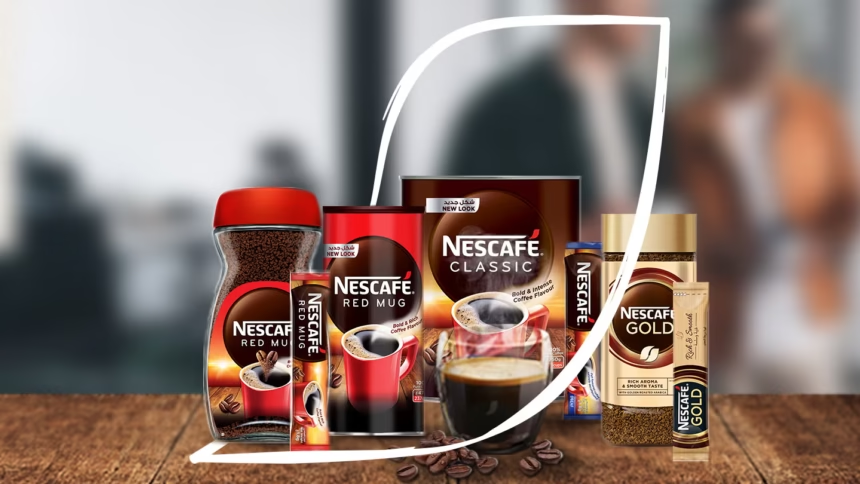
The company describes coffee as its largest business, with major brands including Nescafé, Nespresso and Starbucks. It is also expanding beyond traditional instant coffee into cold coffee, ready-to-drink products and newer formats designed for at-home consumption.
That change is easy to spot in products such as Nescafé Espresso Concentrate, which allows consumers to make iced coffee at home without specialist equipment.
The opportunity goes beyond convenience. Younger consumers are entering the category through cold coffee, while consumers generally are looking for more café-style experiences at home. Nestlé says ready-to-drink coffee is currently the fastest-growing coffee segment globally, with double-digit growth.
The numbers are beginning to reflect that strategy. In the first half of 2026, Nestlé reported 7.5% organic growth in coffee, driven by Nescafé.
Petcare Is Becoming More Than Pet Food
Petcare is another major part of the company’s strategy.
The underlying idea is straightforward: pets are increasingly treated as members of the household, and owners are willing to spend more on products connected to nutrition, health and wellbeing.
Nestlé’s Purina business is therefore moving beyond conventional pet food into premium products, supplements and veterinary diets. The company identifies therapeutic pet food as a fast-growing area and is investing in products designed to support specific health needs.
There is also a geographic opportunity. While premiumisation is particularly relevant in established markets, commercial pet-food adoption is increasing in emerging markets. Nestlé says Purina is expanding distribution and offering products across different price points in those markets.
Emerging Markets Matter More
Perhaps the most important part of the strategy is geographical.
Nestlé is putting greater emphasis on markets where consumer demand still has room to expand significantly. India, Indonesia and parts of Africa are among the markets where the company has reported strong recent momentum.
In its first-quarter 2026 results, Nestlé reported 6.8% organic growth in emerging markets excluding China, with India, Indonesia and Central and West Africa among the areas delivering RIG-led growth.
India offers a useful example of how the company is approaching these markets. Nestlé says Maggi achieved strong double-digit organic growth and real internal growth there, helped by affordable price points and flavour innovation aimed at younger and rural consumers.
This is not simply about selling more of the same products. Local tastes, purchasing power and consumption habits can determine which products actually scale.
A Leaner Nestlé
The strategy also involves doing less in some areas.
Nestlé says it is reviewing smaller or non-core assets, rationalising parts of its portfolio and simplifying its organisational structure. It is also targeting CHF 3 billion in cost savings by the end of 2027, with the intention of redirecting resources towards growth and innovation.
That makes the strategy as much about focus as expansion.
Rather than launching countless products across every possible category, Nestlé says it wants to build larger, multi-year innovation platforms and scale successful ideas more quickly.
What Comes Next?
Nestlé’s latest strategy reflects a broader shift taking place across the global consumer-goods industry.
Consumers want convenience, premium experiences and products that fit changing lifestyles. At the same time, emerging markets offer large populations of consumers whose purchasing habits are still evolving.
Coffee, petcare and selected nutrition and food categories sit neatly within those trends.
Whether the strategy delivers everything Nestlé expects will depend on execution, pricing, competition and consumer demand. But the direction is clear: the company is concentrating resources on fewer areas, backing established global brands and looking for growth in both new consumption occasions and faster-developing markets.
For a company with Nestlé’s enormous portfolio, knowing where not to spread its attention may prove just as important as deciding where to invest next.