


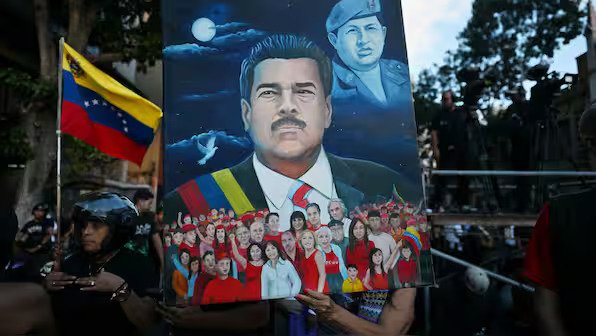
In early January 2026 the world watched in shock as the United States launched a dramatic military operation in Venezuela, resulting in the capture of President Nicolás Maduro and his wife. U.S. President Donald Trump announced that American forces conducted a “large-scale strike” against Venezuelan targets and apprehended Maduro, who was then flown to the United States to face federal charges, including narco-terrorism and drug trafficking.
This unprecedented action marks one of the most significant escalations in U.S.–Venezuela relations in decades, setting off a chain reaction of diplomatic, humanitarian, and regional consequences.
Historical Roots of the Conflict
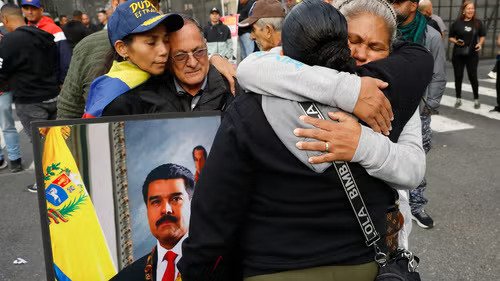
The strained relationship between the U.S. and Venezuela dates back to the late 20th century but intensified sharply under Hugo Chávez and continued under Maduro. Venezuela’s socialist government, hostile rhetoric toward U.S. foreign policy, and alliances with Cuba, Russia, and Iran positioned it as a perpetual antagonist in Washington’s view.
Over the past decade, the U.S. government labelled Venezuela’s ruling elite, especially Maduro, as corrupt and repressive. Sanctions mounted, including the designation of Venezuelan officials and groups like the Cartel de los Soles as terrorist organisations, and a $50 million reward was offered for information leading to Maduro’s arrest.
What Actually Happened?
In early January, U.S. forces initiated coordinated strikes on key military and infrastructure sites in Caracas and other parts of Venezuela. Within hours, Maduro and his wife were reportedly taken into custody and transported to New York to face charges.
President Trump stated that the U.S. would temporarily “run” Venezuela until a transition could take place and that its vast oil reserves would be managed to “fix” the country’s faltering energy sector. AP News However, U.S. officials later clarified that the country would not administer Venezuela day-to-day, and that Venezuelan institutions and leaders — such as Vice President Delcy Rodríguez (named interim president by Venezuela’s Supreme Court) — would retain authority.
Domestic and International Reactions
The U.S. political sphere erupted in debate. Some lawmakers and former officials denounced the action as unlawful and destabilising, warning it could set a dangerous precedent for global diplomacy and security. New York Post Critics argued the move lacked legal justification under international law, which typically forbids the use of force against the sovereignty of another state without UN Security Council approval or clear self-defence justification.
Internationally, reactions were sharply divided. Countries such as Russia and China condemned the U.S. action as a violation of international law, threatening regional stability and asserting that no nation should act as the world’s “judge” or police. Several Latin American nations also criticised the strike, demanding respect for Venezuelan sovereignty.
Conversely, some Venezuelan opposition figures welcomed the capture as a potential turning point toward democratic reform.
Humanitarian Fallout and Regional Impact
In Venezuela itself, life was thrown into turmoil. Reports from Caracas described power outages, food scarcity, and widespread fear as infrastructure faltered and uncertainty gripped the population.
The political vacuum and military presence have strained relations with neighbouring countries, raised concerns about migration flows, and triggered debates within international organisations such as the United Nations, which scheduled emergency sessions to discuss the crisis.
What Does This Mean Going Forward?
The implications of Maduro’s capture extend far beyond Venezuelan borders:
- Legal and diplomatic norms may be tested as the world watches how international law interprets the detention of a sitting head of state.
- Regional stability is precarious; Latin American nations are likely to reassess alliances and defence strategies.
- The U.S. faces domestic and global criticism for its approach, shaping future foreign policy debates and elections.
This moment reshapes the geopolitical landscape of the Western Hemisphere and raises difficult questions about sovereignty, justice, and the balance of power in the 21st century.








A mobile phone that performs many of the functions of a computer, typically having a touchscreen interface, internet access, and an operating system capable of running downloaded applications.
If you have an idea of what type of camera you’re looking for, you can look at the list up top for a quick recommendation.
I believe that the past 25 years of my 50-year-old, technology-laced life have only been an incubator for a silicon chrysalis designed to blur the lines between virtual, augmented, and real-reality.