


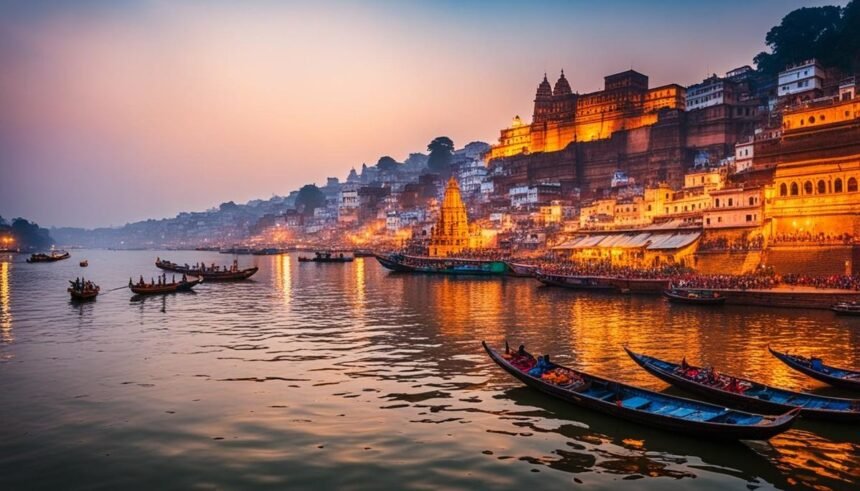
There is a specific, heavy scent that hangs over the Ganges at 4:00 AM—a thick mixture of river silt, burning camphor, and the faint, sweet decay of marigold garlands. It’s a smell that hasn’t changed in three millennia. In Varanasi, time isn’t a straight line; it’s a circle, repeating itself with every dip in the holy water and every flame offered to the dark.
To visit Varanasi (Kashi) is to step into the oldest living city on Earth. But to witness it at dawn is to see the gears of the universe turning in real-time.
The Blue Hour on the Ghats
Before the sun breaks the horizon, the stone steps—the ghats—are a theater of the quietest human intimate moments. While the rest of the world is waking up to digital alarms, Varanasi wakes up to the rhythmic slap of laundry against stone and the low, guttural chanting of Sanskrit prayers.
Taking a wooden boat out onto the river at this hour is essential. From the water, the city looks like a crumbling fortress of faith. You’ll see the Dashashwamedh Ghat, where the previous night’s fire ceremony still feels electric in the air, and the Manikarnika Ghat, where the eternal fires of cremation flickers. It sounds grim to a Western ear, but here, death is treated with a startling, lived-in familiarity. It is simply the final transition in a city that has seen millions come and go.
The Geometry of Faith
As the sun finally hits the water, the city turns a bruised shade of gold. This is when the “Life of the River” truly begins. You’ll see pilgrims from across the globe submerged to their chests, their faces turned toward the rising sun in a gesture of Arghya.
The architecture of Varanasi is a beautiful, chaotic mess. Temples lean at impossible angles—like the Ratneshwar Mahadev, which is partially submerged in the river—as if the earth itself is trying to reclaim the stone. There is no “city planning” here; there is only the organic growth of a civilization that refused to die out when the Romans or the Persians did.

Why Varanasi Persists
We live in an era of the “temporary.” Our buildings are glass, our news cycles are hourly, and our attention spans are fractured. Varanasi is the antidote to that. It matters because it is a place where “forever” is a tangible concept. When you walk the narrow, cow-crowded alleys of the Old City, you realize that the person standing next to you is performing the exact same ritual their ancestor did in 500 BCE.
SEO Travel Tip: If you want to avoid the “tourist trap” feel, skip the main ghats for a moment and head to Assi Ghat at the southern end. The Subah-e-Banaras (Dawn of Varanasi) program there offers a more soulful, less crowded introduction to the morning rituals, including Vedic chanting and classical music that resonates better in the morning chill.
Editor’s Note: The Reality of the Ritual
Don’t come here expecting a sanitized spiritual retreat. Varanasi is loud, dusty, and unapologetically raw. But if you sit still on a stone step and watch the light change on the water, you’ll feel a strange sense of peace. It’s the peace of realizing that the world has been turning for a long time, and it will keep turning long after we’re gone.