


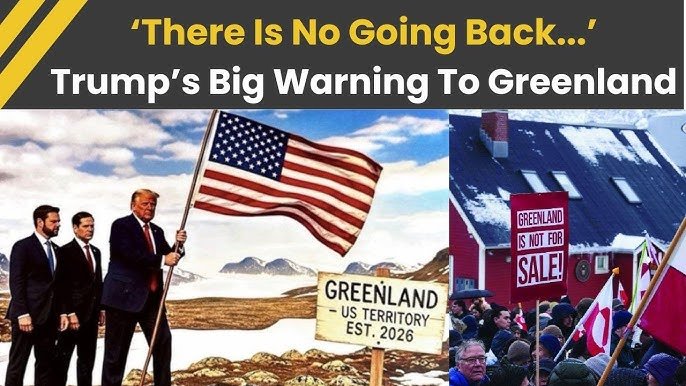
When U.S. President Donald Trump arrived at the World Economic Forum (WEF) in Davos, Switzerland this week, world leaders expected discussions on global economic cooperation, climate initiatives and geopolitical stability. Instead, the spotlight quickly turned to one of the most controversial topics in international relations today: Trump’s emphatic bid to assert U.S. control over Greenland, a vast Arctic territory primarily governed by Denmark. What began as an unusual geopolitical suggestion has now snowballed into a serious diplomatic dispute with deep implications for NATO, European unity and the post-war global order.
Greenland: Strategic Prize or Diplomatic Red Flag?
Greenland is the world’s largest island, positioned in the Arctic Circle and politically part of the Kingdom of Denmark. Its geography makes it strategically important — especially as climate change opens new Arctic shipping routes and rival powers like Russia and China expand their presence in the region. Trump and his top officials argue that U.S. control of Greenland would provide a security advantage in the Arctic, framing it as essential for “national and world security.” Trump even declared there’s “no going back” on his push for the territory.
But European leaders have seen this rhetoric not as strategic diplomacy, but as a provocation with serious consequences. In Davos and in capitals across Europe, officials are warning that any hostile push — especially talk of tariffs or coercive tactics — could undermine decades of post-war alliance building and mutual trust.
Transatlantic Rift Deepens
Rather than easing concerns, Trump’s statements and actions appear to have deepened divisions within the transatlantic alliance:
- Tariff threats: Trump has threatened to impose tariffs of 10 % on goods from eight European countries — including France, Germany and the United Kingdom — that participated in joint exercises in Greenland, with the rate set to increase if no deal is reached. European leaders view this as economic coercion among allies and a blatant attempt to force agreement on Washington’s terms.
- Allied pushback: European Commission President Ursula von der Leyen publicly criticized the tariffs as a “mistake” between long-standing partners and warned that any trade retaliation would be “unflinching, united and proportional.” French President Emmanuel Macron has echoed these sentiments, emphasizing respect for sovereignty and rule of law over what he has described as provocative diplomacy.
- NATO unity questioned: NATO’s role, historically a cornerstone of collective defense for Europe and North America, has come under scrutiny. Critics argue that a member state pursuing territorial ambitions against another member’s territory — even indirectly — could undermine the very alliance meant to guarantee mutual security.
Denmark and Greenland Respond
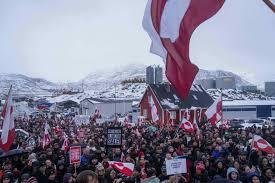
Denmark has been firm in rejecting any suggestion that Greenland is for sale. Both Danish officials and Greenland’s own leadership have emphasized that any change in status must respect international law, sovereignty and the wishes of Greenland’s people. Protests have erupted in Greenland and Denmark under the slogan “Greenland is not for sale,” reflecting popular sentiment against external pressure.
Greenland’s prime minister has publicly stated that the barrage of threats and rhetoric must stop, calling for respect and dialogue instead of unilateral demands.
Wider Global Implications
The Greenland row has broader implications beyond the Arctic itself:
- Trade and alliance cohesion: Threatening tariffs on allied nations complicates ongoing negotiations on trade and cooperation. It risks triggering a backlash that could ripple through diplomatic, defense and economic frameworks critical to global stability.
- Geopolitical rivals weigh in: Russia’s foreign minister has criticized Western disunity, suggesting that NATO’s internal tensions signal a crisis in the alliance and could embolden non-Western powers.
- Ukraine and other initiatives delayed: According to reports, Trump’s Greenland controversy has overshadowed other potential agreements, including a major economic support package for post-war Ukraine, highlighting how one issue can ripple across multiple geopolitical arenas.
What This Means for the Future
Trump’s use of Davos to escalate his Greenland campaign has revealed deep fissures in the traditional transatlantic relationship. Instead of a collaborative forum focused on economic and environmental agreements, Davos is now a stage for a diplomatic standoff that could redefine U.S.–Europe relations for years to come.
Whether the controversy ultimately leads to compromise, retaliation, or continued stalemate remains uncertain. What is clear is that Greenland — a land of ice, resources and strategic significance — has become a flashpoint testing the resilience of alliances that have shaped the global order for decades.