



Israel’s recent decision to cut ties with several global organisations has sparked widespread international discussion, raising important questions about diplomacy, multilateral cooperation, and the future of global governance. While tensions between nations and international bodies are not new, Israel’s move highlights a growing strain between sovereign states and institutions designed to foster cooperation, accountability, and shared responsibility.
Understanding the Decision
Israel’s decision to sever ties with certain global organisations comes amid long-standing disagreements over policy, political positioning, and perceived bias. Israeli officials have argued that some international bodies have repeatedly taken positions they view as unfair, one-sided, or hostile to Israel’s national interests. According to government statements, these organisations no longer serve as neutral platforms but instead function as political tools that undermine Israel’s legitimacy on the global stage.
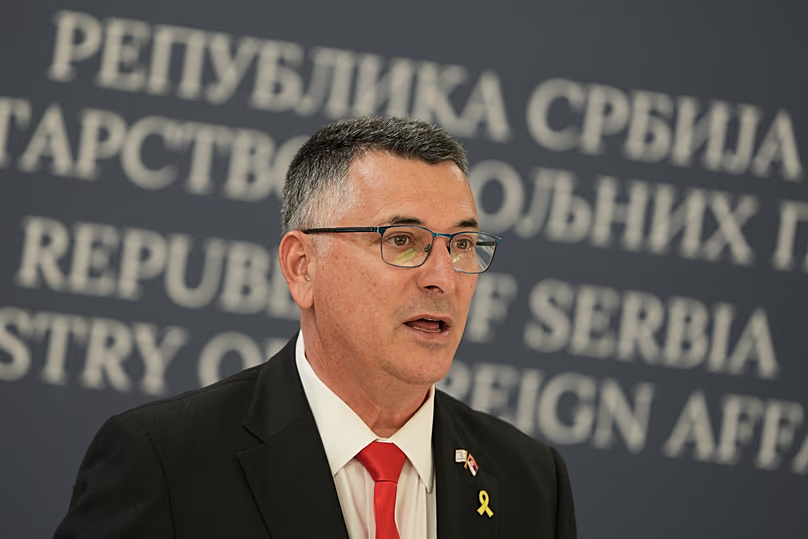
From Israel’s perspective, disengagement is a form of protest — a signal that continued participation is no longer productive when outcomes are seen as predetermined or politicized. By cutting ties, Israel aims to assert its sovereignty and challenge what it sees as institutional imbalance.
A Broader Global Context
Israel’s move does not exist in isolation. Around the world, governments are increasingly questioning the role and effectiveness of global organisations. In recent years, several countries have withdrawn from, suspended funding to, or openly criticized international bodies over issues such as governance, transparency, and political neutrality.
This growing skepticism reflects a broader shift toward nationalism and unilateral decision-making. Many governments now prioritize domestic political considerations over multilateral consensus, especially when international institutions appear disconnected from on-the-ground realities or public sentiment at home.
Diplomatic and Political Implications
Cutting ties with global organisations can have far-reaching diplomatic consequences. International bodies often serve as platforms for dialogue, conflict resolution, humanitarian coordination, and policy alignment. Stepping away from these forums risks reducing opportunities for engagement, negotiation, and influence.
For Israel, this decision may strengthen support among domestic audiences who favor a firm stance against perceived international pressure. However, it may also complicate relationships with allies who value multilateral cooperation and rely on global institutions to manage complex regional and international challenges.
Diplomatically, such moves can deepen divisions rather than resolve them. Critics argue that disengagement limits Israel’s ability to counter criticism from within these institutions and could allow opposing narratives to dominate without challenge.
Impact on International Organisations
From the perspective of global organisations, Israel’s withdrawal raises concerns about legitimacy and effectiveness. These institutions rely on participation from member states to fulfill their mandates. When nations disengage, it weakens collective action and undermines the principle of international cooperation.
At the same time, Israel’s decision may prompt internal reflection within these bodies. Questions about fairness, representation, and accountability are likely to resurface, potentially leading to calls for reform. Whether such introspection leads to meaningful change remains uncertain.
Regional and Global Reactions
Reactions to Israel’s decision have been mixed. Supporters view it as a justified response to institutional bias, while critics warn that it sets a troubling precedent. Some fear that if more countries follow suit, global organisations could become increasingly fragmented and ineffective.
In the Middle East, where diplomatic tensions are already high, the move adds another layer of complexity. International organisations often play roles in humanitarian aid, peacekeeping, and mediation in the region. Reduced cooperation could impact these efforts, with consequences that extend beyond politics to affect civilians on the ground.
What Comes Next
The long-term impact of Israel cutting ties with global organisations will depend on how both sides respond. If disengagement leads to dialogue and reform, it could mark a turning point in how international bodies operate. If not, it may further entrench divisions and weaken multilateral systems already under strain.
Conclusion
Israel’s decision to cut ties with global organisations reflects a broader global tension between national sovereignty and international governance. It underscores growing dissatisfaction with multilateral institutions and highlights the challenges they face in maintaining credibility and neutrality. As global politics continue to evolve, this development serves as a reminder that cooperation, trust, and reform are essential for international institutions to remain relevant in an increasingly divided world.